Source: https://de.wikipedia.org/wiki/Datei:Bimota_YB7.jpg#filelinks

Lizenz: https://creativecommons.org/licenses/by/2.0/deed.en
| Designer | Frederico Martini | Premiere | Cologne 1988 |
| Production period | 1988 – 1989 | Production number | 321 |
| Power | 48 KW (65 PS) | Displacement | 399 cc |
| Topspeed | 220 km/h | Weight | wet 183 kg dry 162 kg |
| Listenpreis | 2.120.000 Yen (1988) | Colours | 161 red / white /gold 124 white / red / green 15 red / white / blue |
| Technical basis | Yamaha FZ 400 |
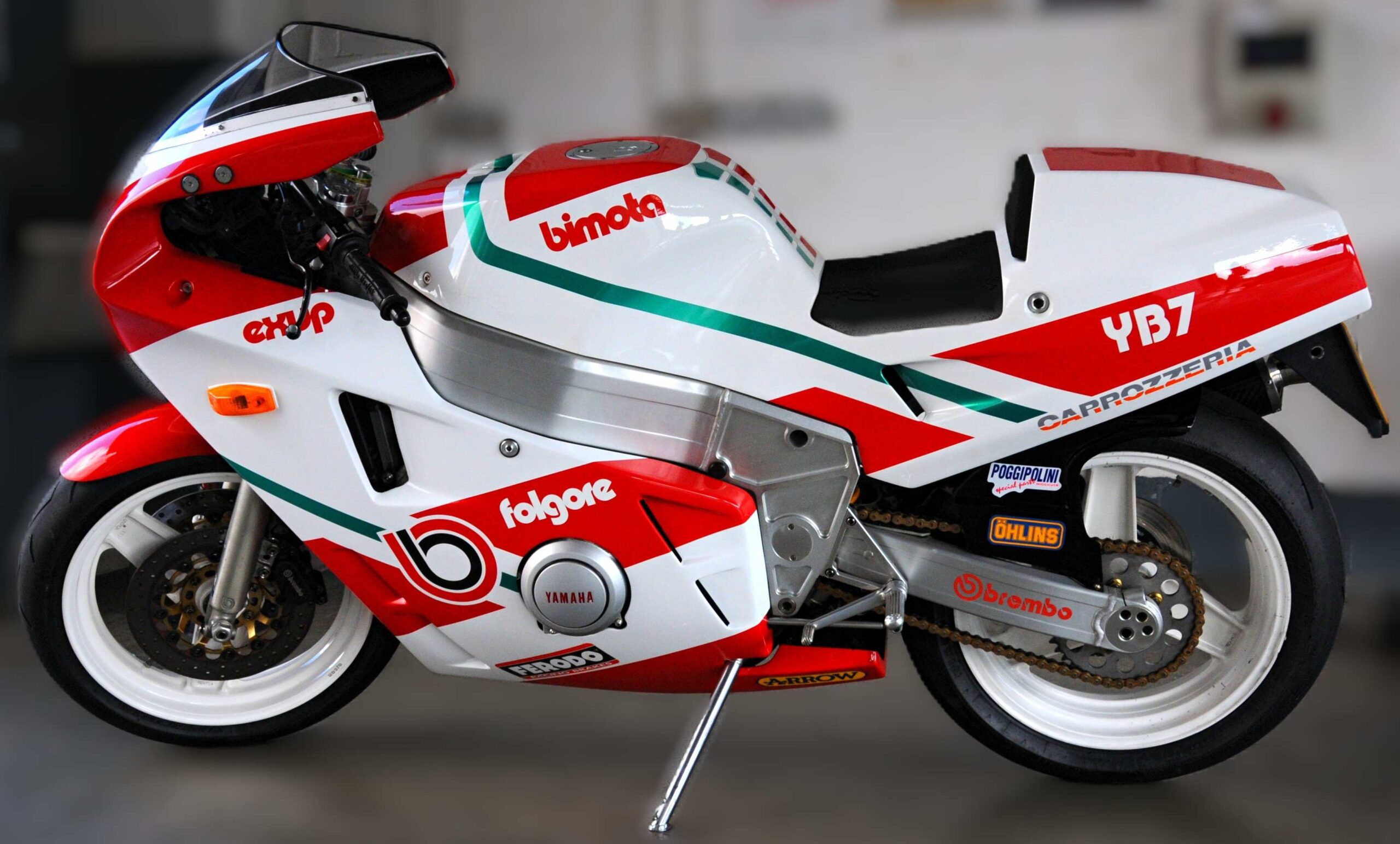
In 1988, Bimota introduced the YB7, a model that was offered exclusively with a 400 cc engine. Although it was presented in Cologne, it was primarily intended for the Japanese market, where motorcycles up to 400 cc are in high demand. They are not only cheaper in terms of taxes and insurance, but above all, obtaining a license for them is significantly easier than for larger-displacement motorcycles. For those, a rather demanding practical exam must be completed, specifically designed to test the handling of heavier bikes.
Japan is also one of Bimota’s most important markets. About three-quarters of the DB1, produced since 1985, were delivered to Japan, and in 1986, the DB1 400 J became the first model specifically developed for the Japanese market. It was therefore only logical to offer a 400 cc version of the successful YB4 and YB6 for the Japanese market.
The engine of the YB7 is the four-cylinder, four-valve DOHC unit from the Yamaha FZ 400, a model sold exclusively in Japan. In addition to a frame with thinner walls, the braking system was adapted to the lower power output, featuring 280 mm front discs. The rear tire was reduced from 180 mm to 160 mm. Trail, steering head angle, and wheelbase were slightly smaller than those of its larger siblings, making the motorcycle extremely agile – especially due to its lower weight, primarily achieved through the smaller engine.
The YB7 was available in three color schemes: the classic red/white with gold stripes from the YB4, the same design in dark blue, which aligned with Yamaha’s colors, and a red/white version with a green stripe, which later reappeared on the YB8.