
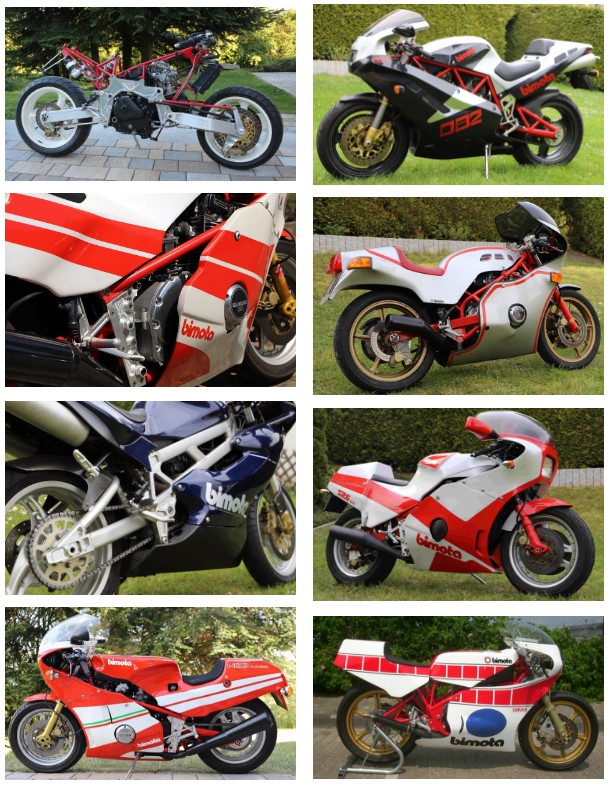
| Designer | Massimo Tamburini | First presentation | Misano 1983 |
| Production- period | 1983 – 1985 | Production numbers | 101 thereof 23 as kits |
| Power | 81 KW (110 PS) | Displacement | 1062 ccm |
| Topspeed | 245 km/h | Weight | wet 239 kg dry 215 kg |
| Price | 33.400 DM (1984) 23.690 DM as kit | Colours | 29 white / red 46 red / white / green 24 red / white / blue 2 grey |
| Technical basis | Honda CB 1100 F | Honda CB 1100 R |
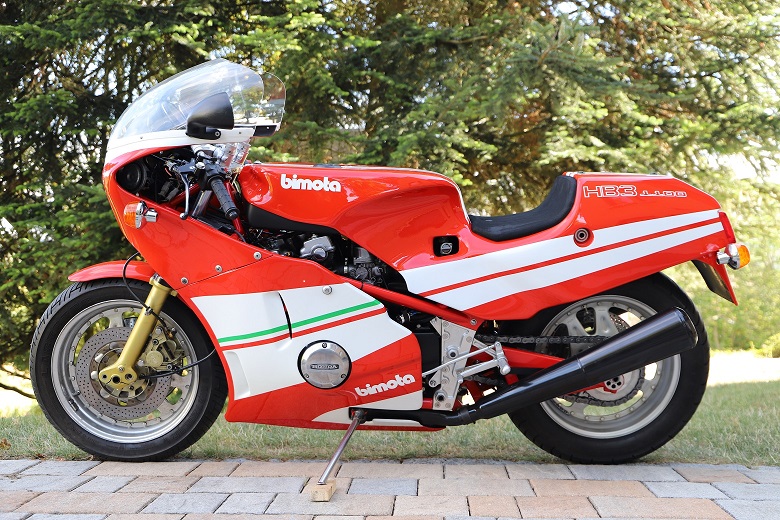
For its 10th anniversary in 1983, Bimota introduced the HB3 as its fourth model, based on the frame design first introduced with the HB2. The HB3 utilizes the technology of the Honda CB1100 F, whose four-cylinder, four-valve DOHC engine (actuated via tappets) delivers 110 hp.
The difference between the donor bike and the HB3, as with all other Bimota models up until the late 1980s, is substantial. At the time, Japanese motorcycle manufacturers were competing to produce ever more powerful and large-displacement engines, but they housed them in conventional chassis. This era gave rise to the term Big Bike, not only referring to large engine capacities but also to considerable weight. The CB1100 F, for instance, has a ready-to-ride weight of 266 kg.
Despite the addition of a full fairing, Bimota managed to reduce the HB3’s weight by almost 30 kg compared to its donor bike.
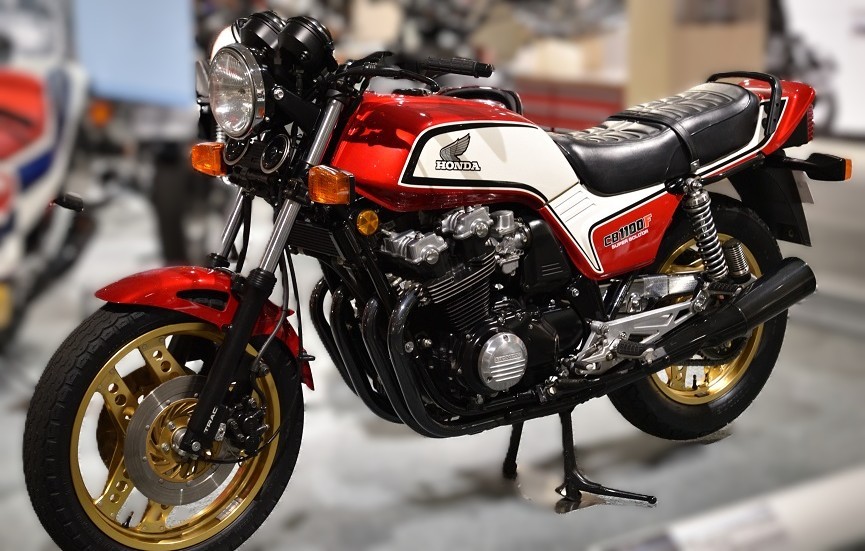
Quelle: https://commons.wikimedia.org/wiki/File:Honda_CB1100F_1983.jpg

Lizenzierungsbedingungen: https://creativecommons.org/licenses/by-sa/4.0/deed.en
All models with this frame construction, as well as the DB1, are equipped with Bimota-designed three-piece 16-inch aluminum wheels. Both the rim bed and the spokes each consist of two stamped aluminum parts. The spokes are bolted to the hollow-cast hub. The rim bed and the spokes are riveted together. In addition, the joint in the rim bed is bonded with a layer of Kevlar, which increases stability while also providing a seal. The 4.25-inch rear wheel rim weighs only 5.8 kg and cost approximately DM 2,200 in 1983.
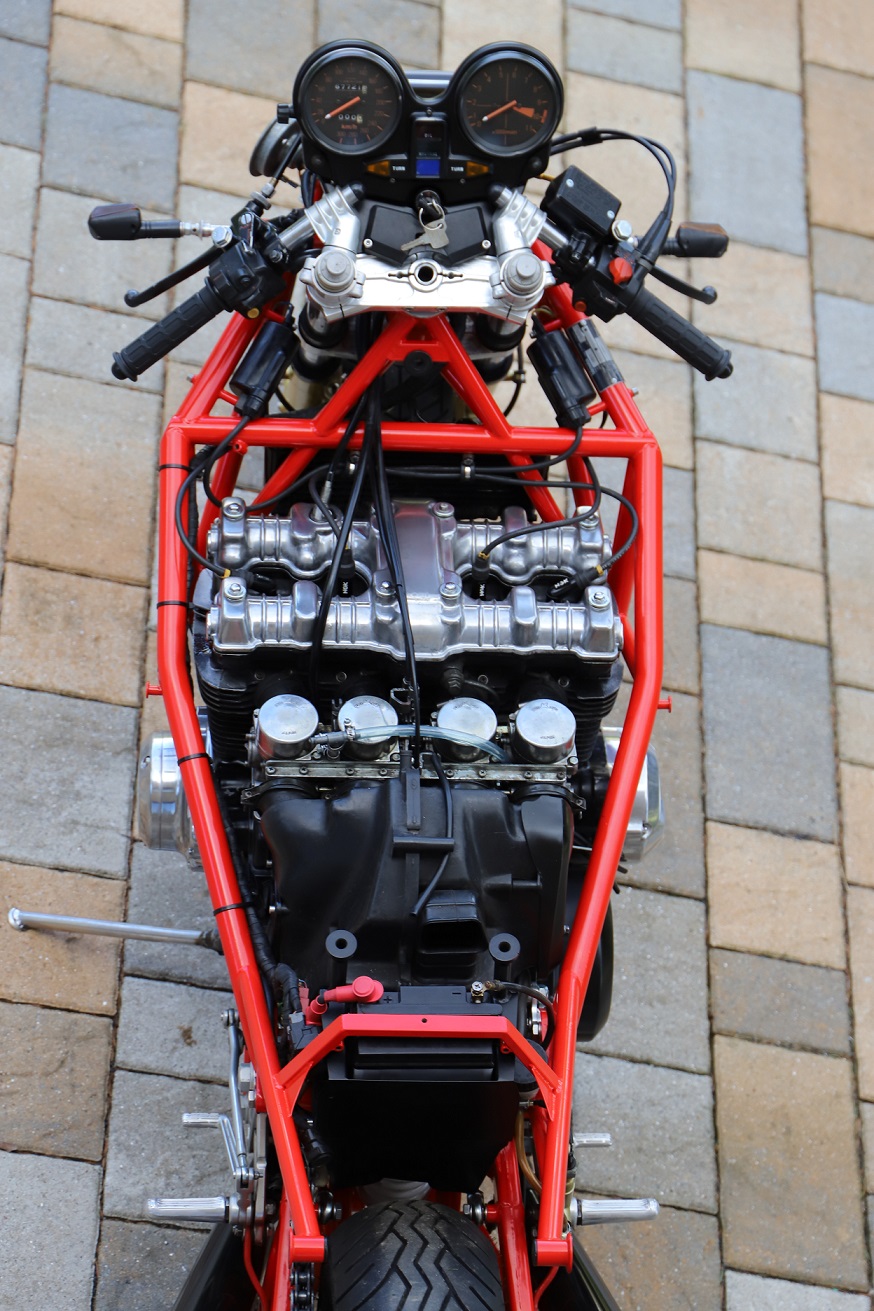
In issue 25/1983, MOTORRAD tested the HB3 in Italy and wrote:
“… The craftsmanship and technical execution of all details of Bimota products compare to cheap mass-produced models like a plate of Tagliatelle con Tartufo to a bowl of rice.” … “The new HB3 possesses qualities that are currently, without question, the benchmark for all things two-wheeled. Despite the chassis geometry clearly designed for agility, with an astonishingly short wheelbase and minimal trail, the Bimota chassis impresses with its excellent straight-line stability.”
Technical specifications and measured values from Motorrad issue 25/1985
- Engine:
– air-cooled inline four-cylinder four-stroke engine, transversely mounted
– bore x stroke 70 x 69 mm
– four valves per cylinder, two overhead camshafts (DOHC)
– valve actuation via bucket tappets
– oil cooler
– displacement 1,062 cc
– compression ratio 9.7 : 1
– rated output 74 kW (100 hp) at 8,500 rpm
– maximum torque 90 Nm at 7,000 rpm
– four Keihin carburetors with 33 mm diameter
– contactless ignition
– multi-plate wet clutch
– five-speed gearbox - Chassis:
– tubular space frame
– Forcella Italia telescopic fork at the front, 40 mm stanchion diameter
– seven-stage damping adjustment, 140 mm suspension travel
– central De Carbon gas-pressure rear shock absorber
– spring preload infinitely adjustable, 110 mm suspension travel
– wheelbase 1,435 mm
– steering head angle 61.5 degrees
– trail 87 mm
– 280 mm dual disc brake at the front
– 280 mm fixed-caliper disc brake at the rear
– tires: rear 150 / 80 VR 16, front 120 / 80 VR 16 - Dimensions and Weights:
– length 2,040 mm
– seat height 730 mm
– turning circle 6,900 mm
– weight fully fueled 239 kg
– weight distribution 116 kg front, 123 kg rear → 48.5% / 51.5%
– fuel tank capacity 20.8 liters, including 2.7 liters reserve - Performance:
– 0–100 km/h in 3.8 s
– 0–200 km/h in 14.0 s
– roll-on acceleration 60–140 km/h in 9.9 s
– top speed 235 km/h at 8,970 rpm
– braking distance 100–0 km/h in 49.1 m
– fuel consumption: 6.8 liters / 100 km